What is the "Start-Stop Loop" in ADHD and how do I break it?
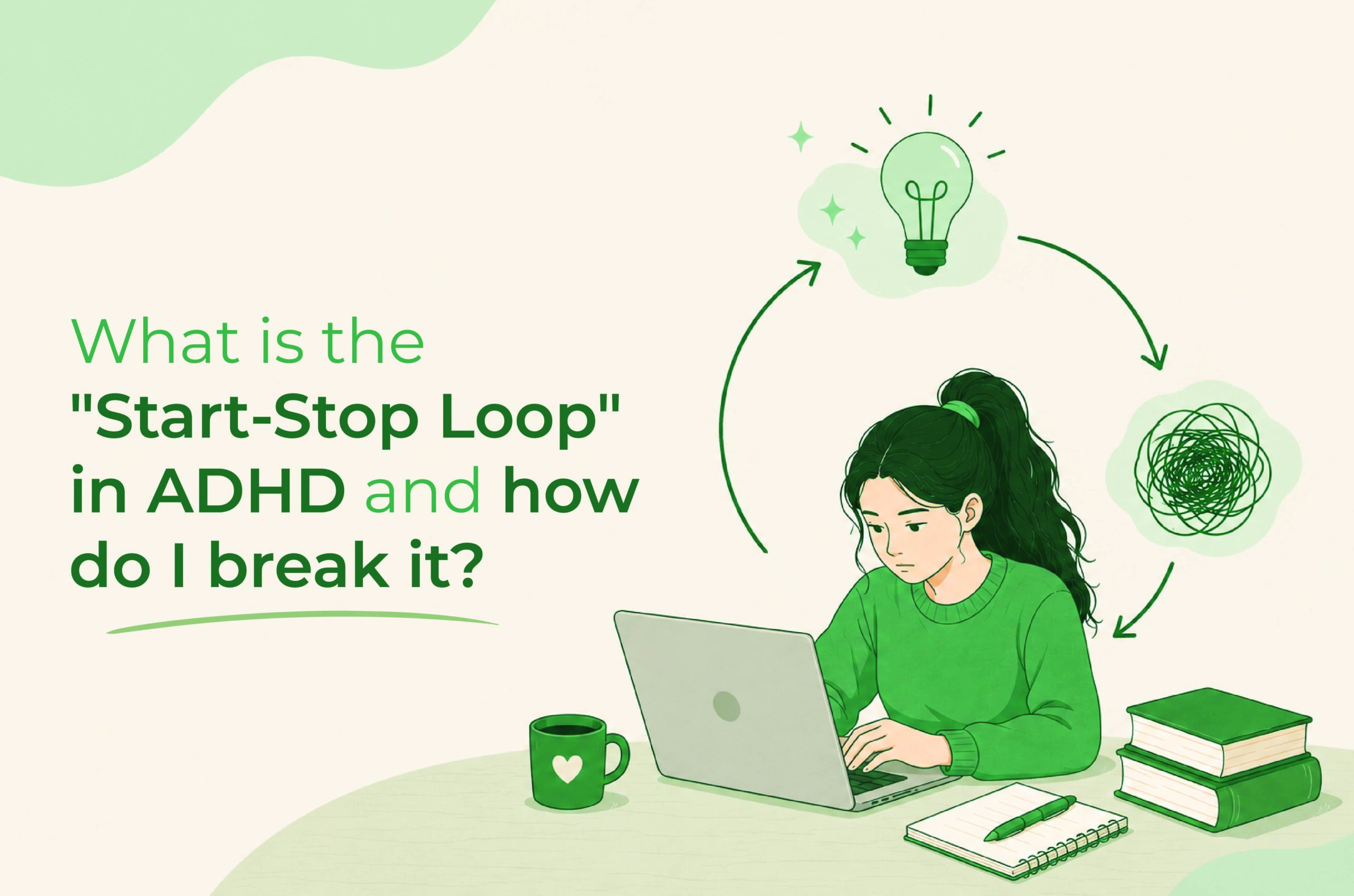
For many adults, the hardest part of ADHD work is not getting started. In fact, starting often comes surprisingly easily. A burst of motivation appears, a new idea feels exciting, and for a brief moment, everything seems possible. But just as quickly, that momentum disappears. The task is left unfinished, guilt begins to build, and returning to it feels harder than starting ever did.
This cycle, often called the “start-stop loop,” is one of the most frustrating experiences for adults living with ADHD. It is frequently misunderstood as laziness, poor discipline, or a lack of commitment. In reality, it reflects how the ADHD brain regulates attention, motivation, and energy over time.
This blog explores why the start-stop loop happens in ADHD work, how it affects confidence and productivity, and the practical strategies that help adults build steadier, more sustainable ways of working without relying on constant motivation.
When motivation fades before the work is done
Many people assume that attention works like a switch that simply turns on or off. For adults with ADHD, attention is more closely tied to interest, urgency, and novelty than to importance. New projects naturally provide stimulation, making it easier to begin with enthusiasm.
As that novelty fades, however, the brain experiences a noticeable drop in motivation. The task itself has not become more difficult, but it feels significantly harder to return to. This pattern is especially common among adults with inattentive ADHD, where difficulties sustaining attention often become more visible after the initial excitement wears off.
Recognising this pattern helps shift the conversation away from willpower. What appears to be inconsistency is often a predictable feature of how ADHD regulates motivation rather than evidence of poor character.
The hidden role of executive dysfunction
The start-stop loop is rooted in executive functioning rather than intelligence or ambition. Executive functions help people plan, initiate tasks, organise information, and transition between activities. When these systems become overloaded, even simple next steps can feel surprisingly inaccessible.
Many adult ADHD symptoms show up in these everyday moments. A person may stare at an unfinished presentation for twenty minutes without knowing how to begin again, despite understanding exactly what needs to be done. These patterns can be especially common in inattentive ADHD, where sustaining attention after the initial burst of interest often becomes increasingly difficult. Others may repeatedly switch between tasks without making meaningful progress, leaving them mentally exhausted by the end of the day.
These experiences are among the lesser-known signs and symptoms of ADHD, particularly in adults who have developed sophisticated coping strategies that hide their struggles from others.
When unfinished tasks become emotional burdens
One unfinished task often becomes many. Every time a project is abandoned, it gathers emotional weight alongside practical work. The longer it remains incomplete, the more intimidating it feels to revisit.
Perfectionism often amplifies this cycle. If the brain believes something cannot be completed perfectly, it may avoid continuing altogether. The result is not a lack of care but an attempt to avoid the discomfort of perceived failure.
For many adults, this emotional layer becomes one of the most overlooked signs of ADHD in adults. They are not avoiding work because they are indifferent. They are avoiding the emotional friction that has become attached to restarting.
Understanding this distinction is an important step toward healthier ADHD work, because it replaces self-blame with curiosity about what the brain actually needs to move forward.
Burnout keeps the loop alive
Another reason the cycle continues is that many adults unknowingly work in extremes. They push through periods of hyperfocus, skip breaks, and accomplish large amounts in a short time. Eventually, their energy crashes, making even routine tasks feel overwhelming the following day.
Without planned recovery, the brain begins associating work with exhaustion instead of progress. Each new project requires increasingly more emotional effort simply to begin.
This pattern explains why productivity systems designed for neurotypical brains often fail during ADHD work. Consistency cannot be built on repeated cycles of overexertion and recovery. Sustainable attention depends on pacing rather than constant output.
Making the first step impossibly small
One of the most effective ways to interrupt the start-stop loop is by lowering the barrier to entry.
Instead of setting a goal like “finish the report,” the goal becomes “open the document” or “write one sentence.” These micro-starts reduce the amount of executive functioning required to begin, allowing momentum to develop naturally instead of waiting for motivation to appear.
This approach is often recommended alongside behavioral therapy for ADHD, where large, overwhelming tasks are broken into smaller actions that feel manageable. Progress becomes easier because the brain is responding to achievable steps rather than intimidating outcomes.
Over time, these small beginnings become evidence that consistency is possible without relying on bursts of inspiration.
Working in shorter rhythms
Many adults assume that longer work sessions produce better results. For ADHD, the opposite is often true.
Working in focused time sprints of fifteen to twenty minutes creates a defined beginning and end. Rather than pushing until exhaustion, adults stop while they still have some energy left. This preserves motivation for the next session instead of draining it completely.
Planning intentional pauses also changes the emotional relationship with work. Rest becomes part of the system rather than a reward that has to be earned.
For adults navigating ADHD work, this rhythm often feels more sustainable because it respects how attention naturally fluctuates throughout the day.
Leaving your future self a clear path
Returning to unfinished work is often harder than starting from scratch because the brain must reconstruct context before it can act.
One helpful strategy is to leave “breadcrumbs” before stopping. Writing the next sentence, listing the next three actions, or leaving a brief note about what comes next removes much of the uncertainty when returning later.
External support can also make a meaningful difference. Body doubling, shared work sessions, visual reminders, or accountability partners reduce the cognitive load of task initiation without replacing independence.
Rather than relying entirely on memory or motivation, these systems create environments where follow-through becomes more accessible.
Building trust instead of chasing productivity
Breaking the start-stop loop is not about forcing yourself to become more disciplined. It is about understanding why the cycle exists and designing systems that work with your brain instead of against it.
Every completed micro-task, every intentional break, and every successful return to an unfinished project helps rebuild confidence. Progress becomes measured not by perfect consistency but by the ability to begin again without shame.
This perspective is especially valuable for adults who have spent years believing their struggles reflected personal failure. Many of the experiences they considered flaws are, in reality, common expressions of ADHD that become more manageable with the right support. Learning to recognise these signs of ADHD in adults helps replace years of self-criticism with a more accurate understanding of how attention, motivation, and executive functioning interact.
Conclusion
The start-stop loop is one of the most common challenges in ADHD work, yet it is rarely a reflection of laziness or lack of commitment. It grows from executive dysfunction, fluctuating motivation, emotional overwhelm, and cycles of burnout that make returning to unfinished tasks feel increasingly difficult.
By understanding the underlying patterns behind adult ADHD symptoms, recognising the signs and symptoms of ADHD, and using practical strategies such as micro-starts, structured work sprints, external accountability, and approaches informed by ADHD coaches or other behavioral therapy for ADHD. Adults can create systems that make progress feel steadier and more sustainable. The goal is not to eliminate every interruption but to make restarting easier, kinder, and more consistent over time.
Ankita Jagtiani Dadachanji is a certified ADHD coach who works with adults navigating executive dysfunction, inconsistent motivation, and the everyday challenges of ADHD work. Through personalized ADHD coaching, she helps individuals build practical systems that reduce overwhelm, strengthen self-trust, and create sustainable ways of working that support long-term well-being.